
On 6 October 2026 Thailand’s justice minister said Shuffle.com held a Curaçao licence and sat outside Thai jurisdiction. Two days later his own ministry said Thai law still applied, the Department of Special Investigation opened an inquiry, and Shuffle stopped taking players from Thailand. Since then the husband of a governing party MP has answered three hours of questions about his old stake in the casino’s parent company, and three Thai exchanges have told parliament that their customers sent money to wallets linked to the site. Nobody has been charged. Shuffle has said nothing in public. We read the hearings, the statements and the posts, and put the story in order.
- The casino: Shuffle.com, a crypto casino and sportsbook run by Natural Nine B.V. under a Curaçao licence. Closed to players in Thailand since 8 October 2026.
- The political link: Taiyang Zhang, husband of Bhumjaithai MP Suchada Zhang Thaensap, held 1.47% of Mixed Order Ltd, the company that owns Shuffle’s operator. Suchada says he sold the stake in January 2026.
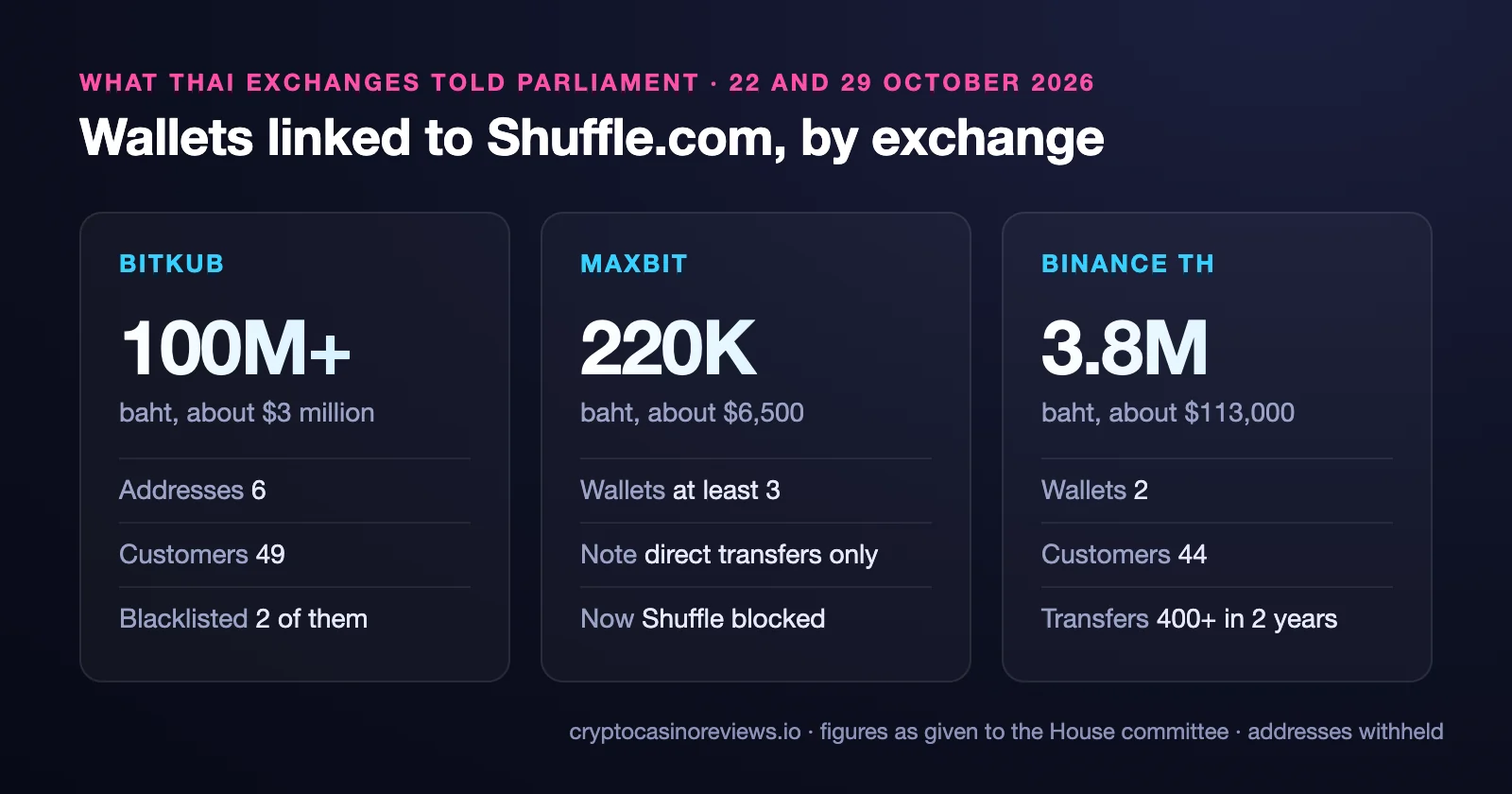
- The money trail: Bitkub found 6 addresses, 49 customers and over 100 million baht. Maxbit found at least 3 wallets and about 220,000 baht. Binance TH found 2 wallets, 44 customers and 3.8 million baht.
- The inquiry: DSI case 148/2569 is still at the fact-finding stage. Zhang is a witness. Police told MPs there is no case against Shuffle yet.
- Shuffle: no public statement on Thailand.
- Next: the House committee meets again on 4 November. The Securities and Exchange Commission is due to be called.
Alex Jovanovic: “Shuffle is one of the casinos we test most closely, so I follow anything that touches its players. In Thailand gambling is illegal for the player as well as the house, and most players there fund a casino from a local exchange. When those exchanges start reading out wallet counts in parliament, every Thai player who ever topped up a casino should know what was said.”
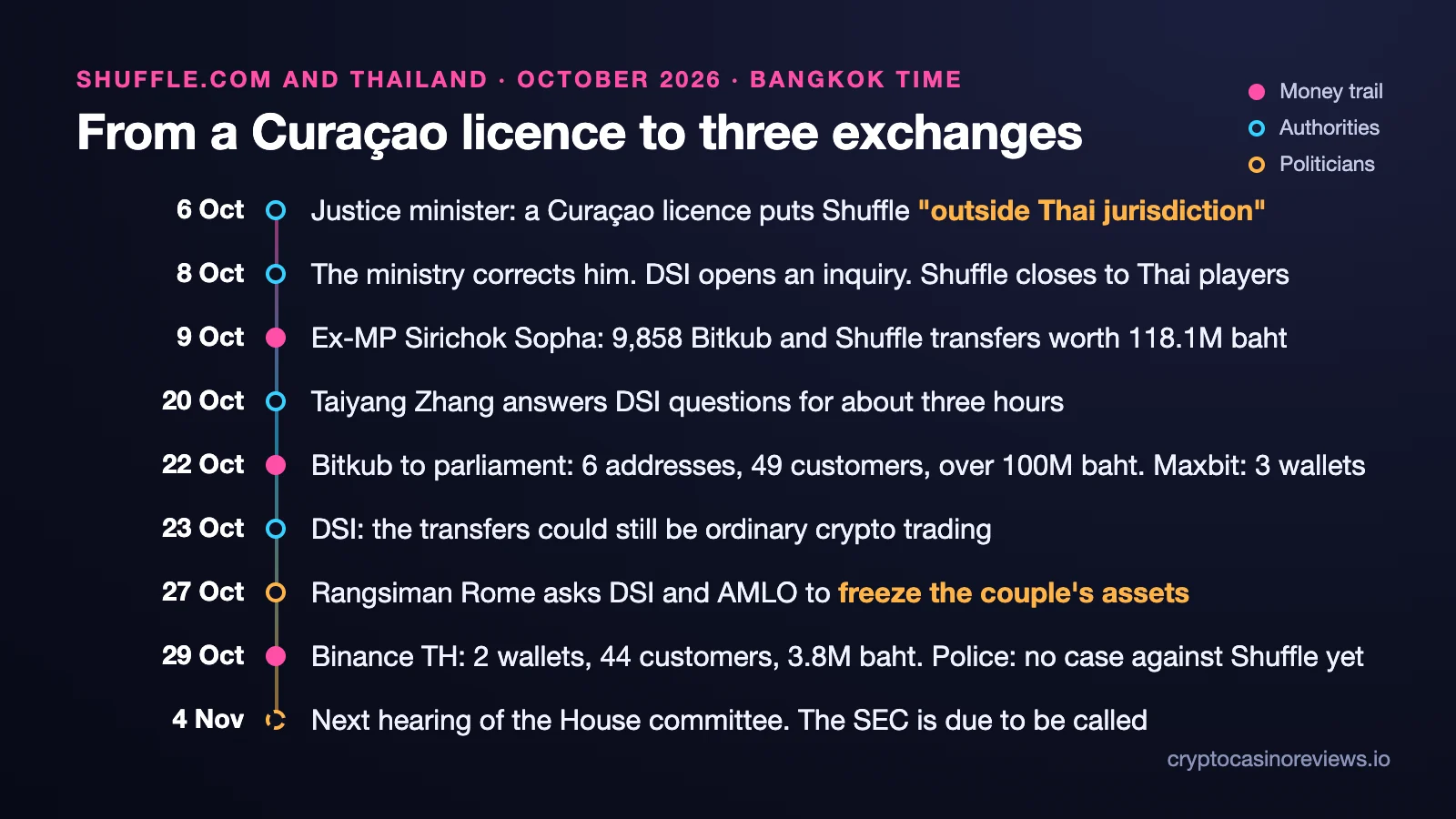
Two answers in two days
The story reached the government in early October. Opposition MPs had linked Taiyang Zhang, an Australian businessman married to Bhumjaithai MP Suchada Zhang Thaensap, to Shuffle. Bhumjaithai leads the government. On 6 October Justice Minister Rutthaphon Naowarat said nobody had filed a formal complaint. He said the DSI had looked at preliminary information and that the company was licensed in Curaçao and outside Thai jurisdiction.
People’s Party deputy leader Wiroj Lakkhanaadisorn answered the same day. He said the state should investigate without waiting for citizens to bring evidence, and pointed to INTERPOL and the Egmont Group of financial intelligence units. A public prosecutor wrote that the minister should reread the Criminal Code.
On 7 October members of the House committee on legal affairs, justice and human rights opened Shuffle from Thailand at about 11:00. The site worked. The couple had been invited to explain their finances that day. Neither came. Suchada sent a letter citing another committee meeting.
On 8 October the Ministry of Justice changed course. A foreign licence does not remove an offence committed in Thailand from Thai law, it said, citing sections 4 to 6 of the Criminal Code and the Gambling Act of 1935. The minister later said the DSI had started its inquiry that day on its own initiative. The same day Shuffle stopped accepting players from Thailand.
Who closed the door
Two accounts exist and they may both be true. On 9 October Patchara Anuntasilpa, permanent secretary of the Ministry of Digital Economy and Society, said the ministry blocked Shuffle after a written notice from police. He said the site may have slipped past the ministry’s screening because it had few Thai users. The ministry says it uses AI, automated monitoring and public complaints, and had blocked about one million illegal URLs in 2026.
Shuffle also closed the door itself. A notice on the site, shared by former Democrat MP Sirichok Sopha, said it no longer accepted players from Thailand “for legal reasons”. Sirichok asked in public who decided that and when. Nobody has answered him.
Alex Jovanovic: “A casino that blocks a country the same week its name reaches parliament is protecting its licence. That is normal. What I want to know is what happens to Thai accounts that still hold a balance. Shuffle has not said, and it is the first thing I would ask support.”
The MP, her husband and 1.47%
Taiyang Zhang is an Australian of Chinese descent. The Bangkok Post reports that he co-founded Ren Protocol, a crypto project that Alameda Research bought in 2021. Shuffle launched in February 2023 and is run by chief executive Noah Dummett, a former Alameda trader. According to the same paper, it now handles more than $2 billion in bets a month. Zhang held shares in Mixed Order Ltd, a British Virgin Islands company that owns Natural Nine B.V., the Curaçao operator of Shuffle. How much he held depends on the day you asked. The figure moved from 1% to 1.4% and then settled at 1.47%.
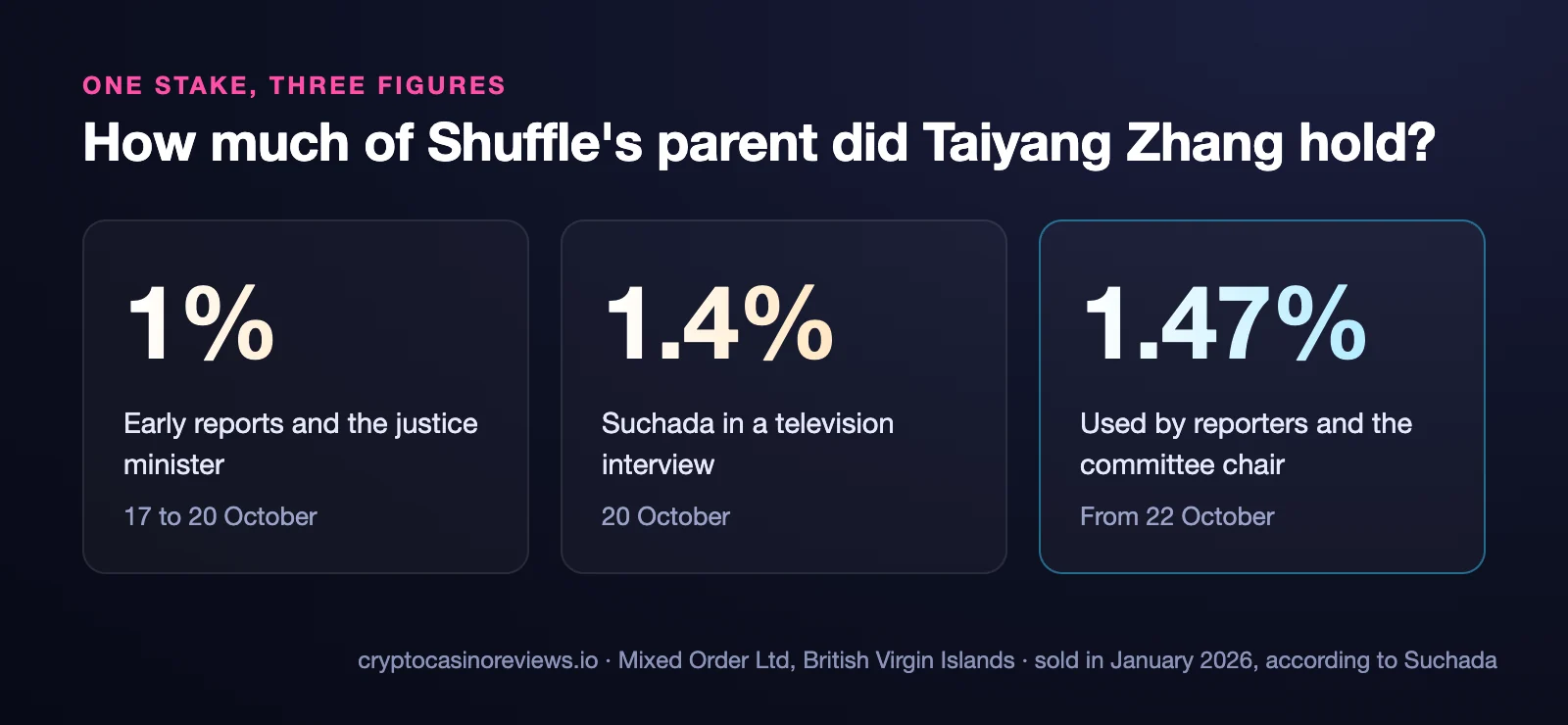
Suchada says he sold the stake in early January 2026, before she won her seat in Chaiyaphum in February. That is why it is not in her January asset declaration to the anti-corruption commission. She has not said who bought it or for how much. Sirichok says the shares were preference shares with wide access to financial information, and that dividends ran above 600 million baht. Those are his claims. Neither has been tested.
The timing is the second question. Suchada became a secretary to Digital Economy Minister Chaichanok Chidchob in October 2025. His ministry is the one that blocks gambling sites. A chart Sirichok published dates the role from 7 October to 22 December 2025, after an earlier post with the higher education minister from October 2023. On the same chart, the Bitkub transfers he counted run from September 2023 to October 2026.
The couple’s declared assets are large. The Bangkok Post counts 1.85 billion baht in Zhang’s name. Other outlets put the couple above 1.9 billion. The biggest single item is a loan of about 1.4 billion baht that Zhang made in 2021 to Three Arrows Capital, the crypto fund that collapsed in 2022.
Suchada calls the whole affair political. Critics, she says, took documents four or five years old and built a misleading story from them. She has filed a defamation complaint against Rangsiman Rome, the People’s Party MP who chairs the House committee. On 20 October she went with her husband to the DSI but did not enter the room. Zhang answered questions for about three hours. Asked if he was nervous, he said: “Not at all.”
Following the money through Thai exchanges
The case turned on 9 October, when Sirichok published a chart built from blockchain records. He counted 9,858 transfers between Bitkub, the largest Thai exchange, and Shuffle from 5 September 2023 to 7 October 2026. By his count 7,884 went from Bitkub to Shuffle, worth about 65.7 million baht, and 1,974 came back, worth about 52.4 million. Together that is about 118.1 million baht, or $3.5 million.
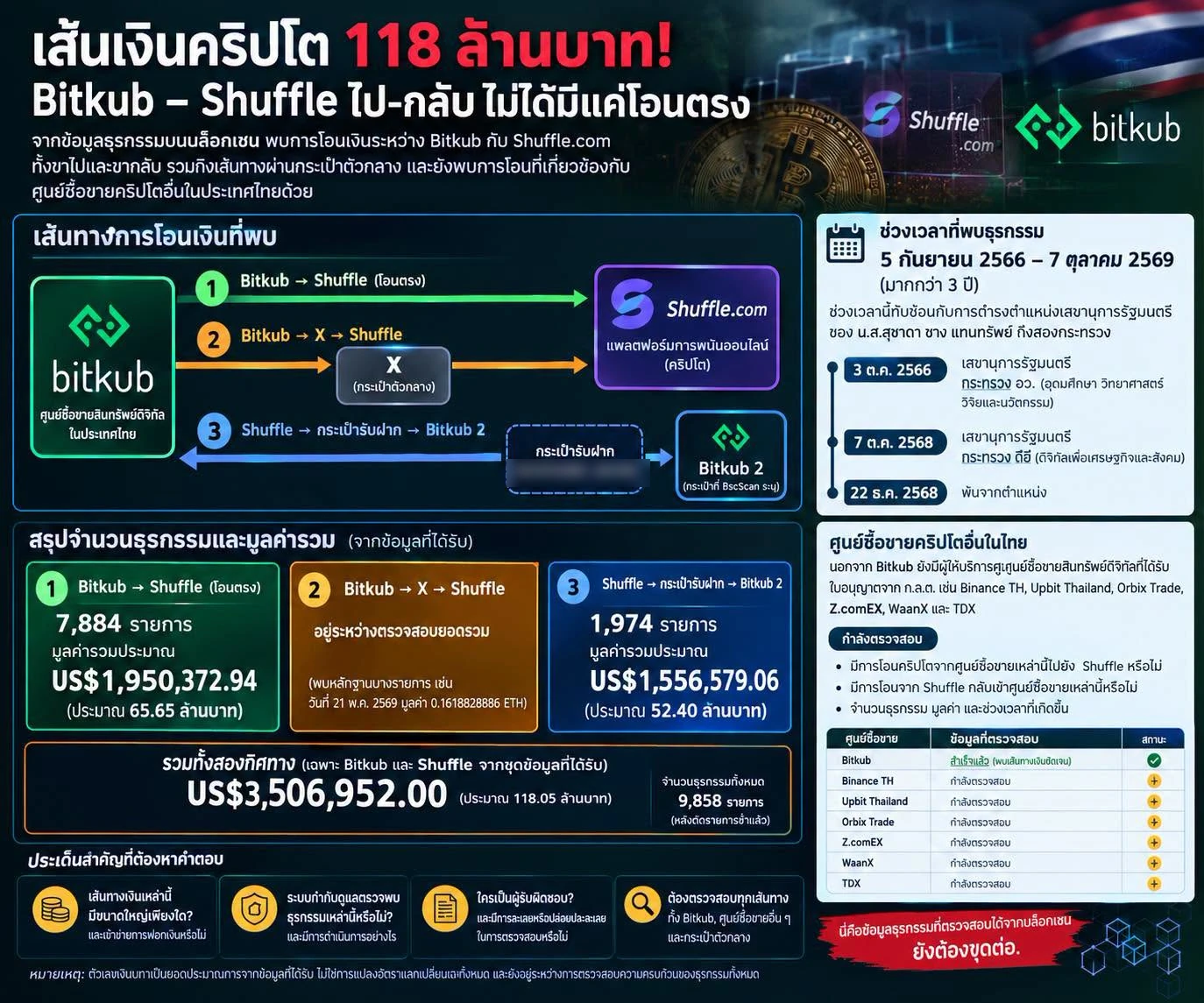
The 7,884 figure spread on X the same morning, through a chart from an anonymous Facebook page. The post below collected about 94,000 views and 5,300 reposts.
Bitkub denied any part in illegal activity that day. It said it follows the law, is inspected by the regulator and was working with the authorities. Sirichok himself said the transfers did not prove Suchada was involved.
On 22 October the exchanges came to parliament. Bitkub told the committee it had found 6 addresses linked to Shuffle, used by 49 customers, with more than 100 million baht in turnover. Two of those addresses had been on its blacklist since 8 and 12 October, after data from the cyber police. The other four were found later. Bitkub then issued a statement. It said it plays no part in running any gambling site and has never invested in or listed the SHFL token. It also said it is preparing for the Travel Rule, which comes into force in Thailand in 2027.
Maxbit found at least 3 wallets. Rangsiman put the total at about 220,000 baht and said that counts direct transfers only, without intermediary wallets. Maxbit said its analytics had not flagged the new addresses in time and that Shuffle addresses are now blocked. It also said it gave the data to the committee of its own accord. The news site Isranews reported that Maxbit’s chief executive is a son of Deputy Prime Minister Pipat Ratchakitprakarn.
Gulf Binance, which runs Binance TH, sent nobody on 22 October. It came on 29 October and reported 2 wallets, 44 customers and 3.8 million baht over two years. Rangsiman said that was more than 400 transactions in and out.
Sirichok keeps one line clear. Buying crypto is legal in Thailand, he says. Using it to gamble is not. An exchange that shows flows to a casino is not guilty of anything by that alone. Democrat deputy leader Korn Chatikavanij, a former finance minister, made the same point from the other side: a blockchain shows grey money more clearly than a bank does, and exchanges that share it should not become scapegoats.
Alex Jovanovic: “Many players think a crypto deposit is private. In this case three exchanges matched customer accounts to casino wallets within weeks, from records anyone can read. If you deposit from an exchange that knows your name, assume the trail exists and that someone can follow it.”
What the DSI says
The DSI, Thailand’s special investigation agency, formed a working group with the Central Investigation Bureau, the cyber police and the Anti-Money Laundering Office. The file is case 148/2569 under its technology crime bureau. Pol Col Piya Raksakul started as the new DSI director-general on 20 October, the day Zhang came in.
On 23 October the agency was careful. What it has so far are allegations, it said, and the transfers could be ordinary crypto trading. Investigators found no Thai influencers or advertising for Shuffle. Players who bet would be treated as witnesses. Gambling cases have no victims under Thai law, so any money seized would go to the state. The minister said a decision on whether to make it a special case, which normally needs damage above 300 million baht, was still open.
Rangsiman wants more speed. On 27 October he gave the DSI a list of 25 documents. He also asked investigators to work with the Anti-Money Laundering Office and freeze the couple’s assets before anything moves. He says Shuffle runs about 40 domains and only 3 of them were blocked.
On 29 October the justice ministry’s permanent secretary, Piyasiri Wattanavarangkul, and Pol Capt Khemchat Prakaihongmanee of the DSI technology crime division said the case is still at the fact-finding stage. The Computer Crime Act of 2007 may apply. The SEC will be invited the following week. The same day police told MPs that no case had been brought against Shuffle. Rangsiman said police should go after the platform instead of individual gamblers, and warned that asking for proof of actual bets would leave a gap for crypto casinos.
Several people stayed away from that hearing. The digital economy minister did not come. Neither did Suchada or her husband. Two of the five Bhumjaithai members of the committee attended.
Numbers that do not match
Most of the figures in this story come from politicians on one side and from reporters quoting them. Several of them moved as the weeks went on.
| Item | Figures in circulation | What we use |
|---|---|---|
| Zhang’s stake | 1%, 1.4%, 1.47% | 1.47%, the latest and most cited |
| Declared assets | 1.85 billion baht in Zhang’s name, over 1.9 billion for the couple | Both, with the owner named |
| Loan to Three Arrows Capital | 1.4 billion and 1.44 billion baht | About 1.4 billion |
| Maxbit transfers | At least 200,000 and about 220,000 baht | About 220,000, direct only |
| Start of the DSI inquiry | 8 October by the minister, 19 October in one report | Work began on 8 October, the case number came later |
| Exchanges with Shuffle flows | Bitkub, Maxbit, Binance TH confirmed. A report of 4 out of 9 platforms | Three confirmed |
What it means if you play from Thailand
- Shuffle is closed to you. The site no longer accepts players from Thailand. Getting round a country block with a VPN breaks the terms of most casinos and can cost you the balance.
- The law covers players. Under the Gambling Act of 1935, playing at an unlicensed casino is an offence for the player too. For now the DSI treats players as witnesses.
- Exchanges are watching. Bitkub blacklisted Shuffle addresses and Maxbit blocked them. A withdrawal to a known casino wallet can be stopped and reported. Exchanges carry their own risks too, as the CoinDCX loss of 15.99 million USDT showed.
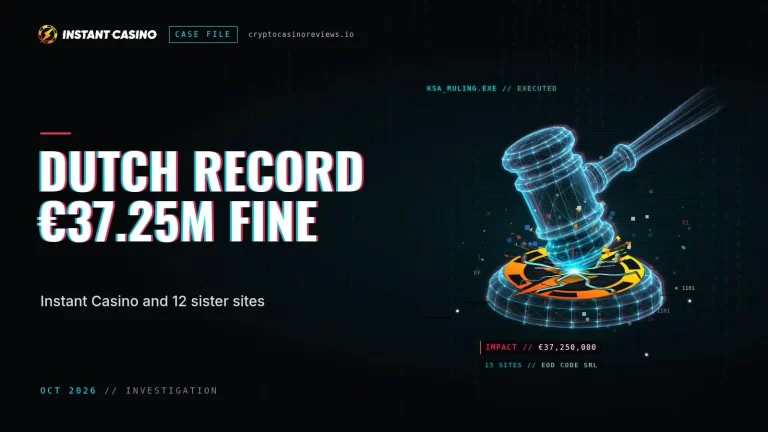
- Regulators elsewhere act too. The Dutch regulator fined EOD Code €37.25M over Instantcasino, Skyhills and ten other sites, and Stake set up a separate company on Alberta’s register to serve players there.
- The trail is permanent. Transfers from an exchange account in your name stay on the chain. The Travel Rule from 2027 will attach more sender data to them.
- If you still hold a balance, ask Shuffle support in writing what happens to it, and keep the reply.
Outside Thailand nothing has changed for Shuffle players. The Curaçao licence of Natural Nine B.V. is active, and our Shuffle review covers the cashier, limits and games.
What is still open
- Who bought Zhang’s stake in January 2026, and at what price.
- Whether the DSI makes it a special case, and whether anyone is charged.
- Whether other licensed exchanges, such as Upbit Thailand, Orbix Trade, Z.comEX, WaanX and TDX, find similar flows.
- Who asked Shuffle to close Thailand, and what happens to Thai balances.
- What Shuffle itself says.
Alex’s verdict
Strip out the politics and two facts remain. Thai players sent crypto to Shuffle from local exchanges for at least three years, and the exchanges could see it once someone asked. Everything else is still a claim. The stake was small and is said to be sold. The DSI calls the evidence allegations, and police have no case against the site. The couple denies any wrongdoing.
For players the lesson is simple. A Curaçao licence does not make a casino legal where you live, and a crypto deposit is not invisible. We looked at that regulator from the inside in our piece on the Casino Secrets leak. If your country bans online gambling, the risk sits with you as well as with the casino.
I will update this post after the hearing on 4 November and when Shuffle speaks. If you played on Shuffle from Thailand and had a balance when the site closed, tell us in the comments what support told you.
How we checked: we read reports by the Bangkok Post, Khaosod, Khaosod English, Thai PBS, MGR Online, Matichon, Isranews, Bangkok Biz News, Nation TV, ASEAN NOW, Thai Examiner, Siam Blockchain and ICONNEX, the statements of Bitkub and Maxbit, and posts on X by Thai Enquirer, Khaosod English and Shuffle up to 29 October 2026. Sirichok Sopha’s figures come from his own chart and posts as quoted in the press. Committee figures are as reported after the hearings. Dates and times are Bangkok time. We do not publish wallet addresses. Shuffle has made no public statement on Thailand, and we will add its answer if it gives one. Our review method explains how we test casinos.
FAQ
Can I play on Shuffle from Thailand?
No. Since 8 October 2026 Shuffle does not accept players from Thailand, and the digital economy ministry has blocked the site. Online gambling at unlicensed casinos is illegal in Thailand for players too.
Is Shuffle under investigation in Thailand?
The DSI is running fact-finding under case 148/2569 into transfers between Thai exchanges and Shuffle and into the stake held by an MP’s husband. As of 29 October 2026 police said no case had been brought against Shuffle and nobody had been charged.
Who is Taiyang Zhang?
An Australian businessman and the husband of Bhumjaithai MP Suchada Zhang Thaensap. He held 1.47% of Mixed Order Ltd, the company that owns Shuffle’s operator, and his wife says he sold it in January 2026. He has spoken to the DSI as a witness.
What did Bitkub find?
Bitkub told a House committee on 22 October 2026 that 6 addresses linked to Shuffle were used by 49 of its customers, with more than 100 million baht in turnover. Two addresses were blacklisted in October. Bitkub says it plays no part in any gambling business.
Did Binance TH send money to Shuffle?
Gulf Binance, the operator of Binance TH, told the committee on 29 October 2026 that 44 of its customers used 2 wallets linked to Shuffle, with 3.8 million baht over two years. Reporting the flows does not mean the exchange did anything wrong.
Is Shuffle safe for players outside Thailand?
The Thai case has not changed Shuffle’s licence. Natural Nine B.V. holds an active Curaçao licence. Read our Shuffle review for payouts, limits and terms before you deposit.
Gambling is for adults only and can become addictive. Play only where it is legal for you, only with money you can afford to lose, and read our responsible gambling guide if it stops being fun.

Written by
Alex writes the house files on Crypto Casino Reviews. He plays the desks he scores and checks the offer, the cashier, and the licence before the long read.
Reader desk
Comments
Played at this casino, spotted a mistake or have a question? Write it here. Alex reads every comment before it goes live.