
On 16 November 2026 an attacker added a crypto address swapper to the Optimizely code of 178 organisations, including Zoom, the BBC, HSBC, Ledger and four gambling brands. For most of the day, a wallet address copied from one of these pages could turn into the attacker’s address. Security researchers call the campaign OPTIMJACK. Here is what it did, how much it earned, where the attacker’s money went, and the checks that protect your next casino deposit.
- What: malicious JavaScript added to customer projects in Optimizely Web Experimentation and served from Optimizely’s own CDN.
- When: 16 November 2026, first injection at 04:21 UTC. Report URI saw every infected file clean by 23:11 UTC.
- Scale: 188 infected snippets at 178 organisations out of 1,611 checked by Report URI. It says the real number is likely higher.
- Payload: address swapper for eight coin types, card skimmer, cookie and screenshot theft, and iPhone exploit kits.
- Crypto received: about $7,000 by Report URI’s count. Galaxy Research’s Alex Thorn puts the victims’ share at about $2,300.
- Gambling sites on the list: Betsson, PokerStars, tombola and Betfred. No crypto casino we review is on it.
- Cause, per Optimizely: a vulnerability in the Experimentation account signup flow. The path is blocked and affected customers were told.
What happened on 16 November
Optimizely Web is an A/B testing tool. A company adds one script tag to its site, and its marketing team changes the pages from the Optimizely dashboard. Each customer project has a field for its own Project JavaScript. According to Scott Helme of Report URI, who found the attack, this is where the attacker put the code. The rest of each snippet was left alone, and the infected file came from cdn.optimizely.com like any other day. In Report URI’s words, “Optimizely’s CDN served exactly what it was given.”
The first injection Report URI found was in the BBC’s snippet at 04:21 UTC. The crypto clipper first appeared on bbc.com at 08:28. At 13:43 the attacker added a card skimmer. Between 17:13 and 17:57 the code gained the Coruna exploit frame for iPhones on iOS 18.6 and older. The mass clean-up ran from about 20:40 to 21:10 UTC. At 21:52 one infected file was left, at TalkTalk. StepSecurity, which published its own analysis, puts the exposure window for most sites at about 16 hours.
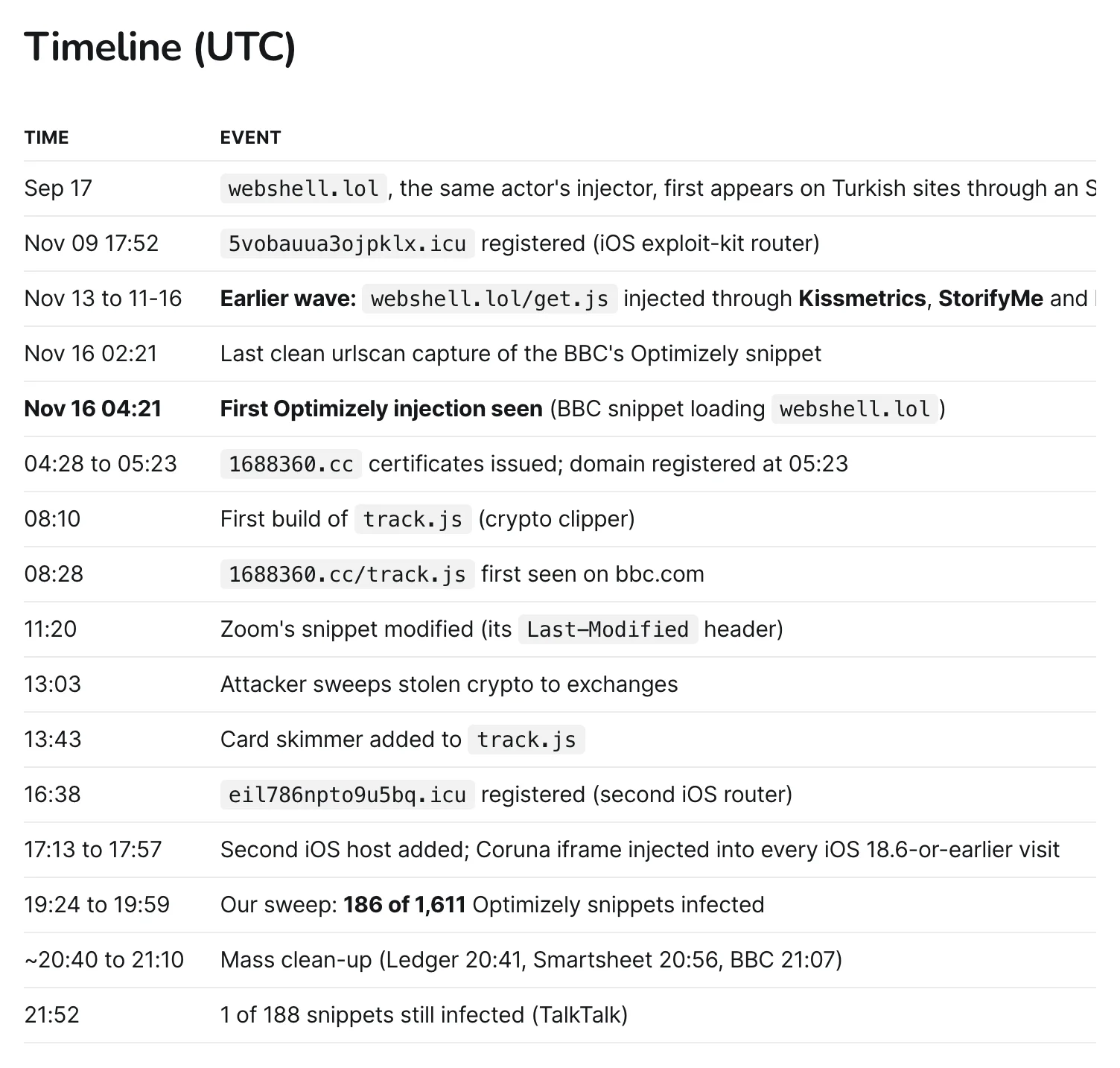
The attacker came back more than once. Smartsheet was cleaned and then infected again, which tells Report URI that “whoever wrote the code still had access at the time”. Report URI counts 26 builds of the payload file on 16 November. Optimizely’s own snippets were on Report URI’s infected list as well.
Optimizely’s fuller statement to BleepingComputer says the attacker “exploited a vulnerability in the Experimentation account signup flow”. The company says it blocked that path, ended active sessions, revoked tokens, reset access for affected user accounts and “blocked any code from being delivered in Cloudflare”. Salesforce told the same outlet it had disabled Optimizely scripts on its preview and production instances as a precaution. Optimizely has not published a list of affected customers or said when the flaw first appeared.
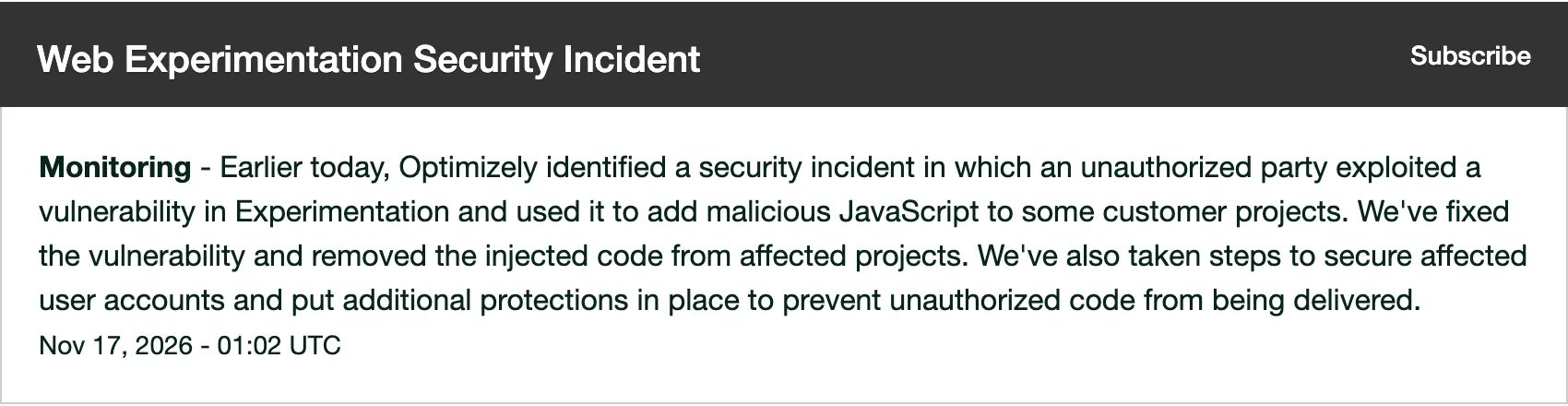
Alex Jovanovic: “Big companies pay Optimizely so that their marketers can change a live website without asking a developer. On 16 November a stranger got the same power through the signup flow, and used it on 178 of them. The status page says Monitoring. So are we.”
How the address swapper worked
The clipper part is the one that matters for anyone who funds a casino balance with crypto. Report URI, StepSecurity and Amirul Cyber agree on the main points:
- It swapped addresses for Bitcoin, Ethereum and other EVM chains, TRON, Solana, TON, Litecoin, Bitcoin Cash and Dogecoin.
- The fake addresses were valid. The code checked the checksum, so a wallet app would accept the pasted address without a warning.
- It worked on text shown on the page, form fields, links and the clipboard. Report URI warns: “Copy an address from any affected page, or from anywhere else while that tab is open, and you may paste the attacker’s.”
- StepSecurity and Amirul Cyber found that it only swapped addresses near words like “wallet”, “deposit” or “send”.
That last condition describes a crypto casino cashier almost word for word. A deposit page shows a wallet address next to the word “Deposit” and invites you to copy it. None of the casinos we review was on the infected list. The risk for players came from the other tabs: a news site, a bank or a SaaS dashboard left open while you copied a deposit or withdrawal address somewhere else.
The rest of the kit:
- Card skimmer. It read card number, expiry date and CVV from payment forms on the page. Cards typed into a payment provider’s own frame, such as Stripe or Adyen, were out of its reach.
- Cookies and screenshots. It sent cookies that were not marked HttpOnly, the page address and a screenshot of the page to the attacker’s server.
- iPhone and iPad. Report URI says devices on iOS 13 to 17 were sent the Coruna kit, iOS 18 got DarkSword, and iOS 26 only had its details recorded. Its advice is to update to iOS 18.7.3 or 26.3 or later. Report URI says it has no way to see how many devices were infected.
Which gambling and crypto sites were on the list
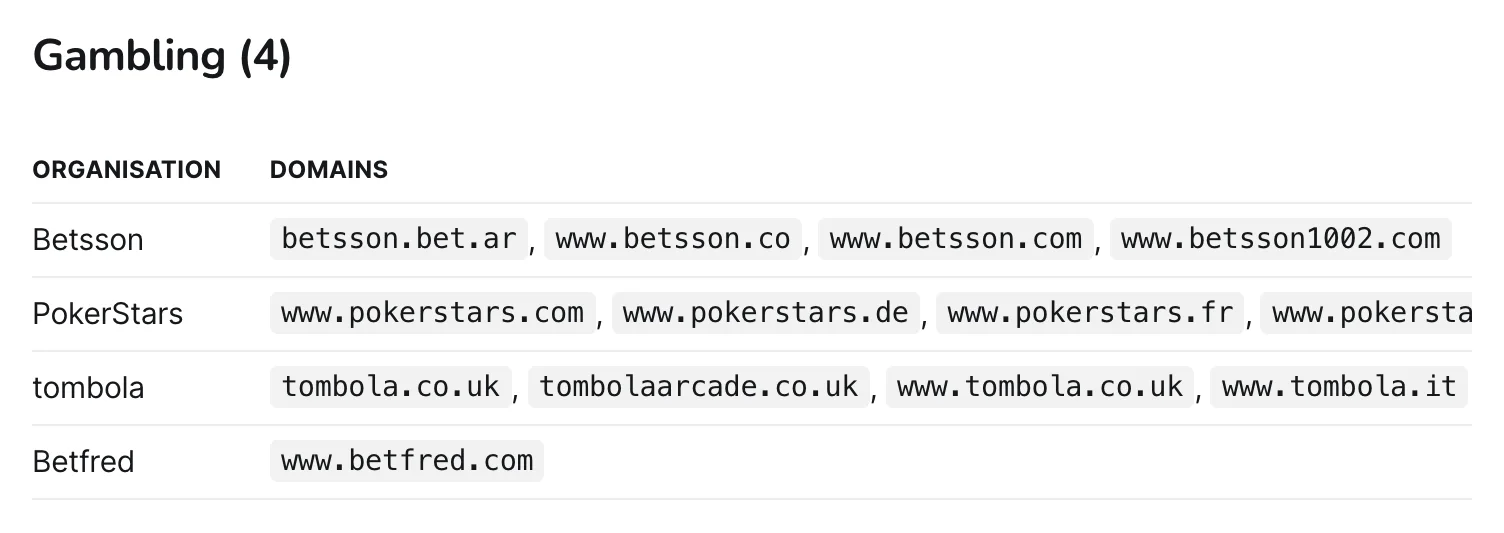
Report URI sorted the 178 organisations by sector. Gambling has four names: Betsson, PokerStars, tombola and Betfred. There is no crypto casino on the list, and neither Gamdom nor Shuffle appears on it.
The Crypto and Trading section has six names: Ledger, IG, OANDA and its Coinpass brand, interactive investor, TMS Brokers and Betashares. Report URI logged Ledger’s clean-up at 20:41 UTC.
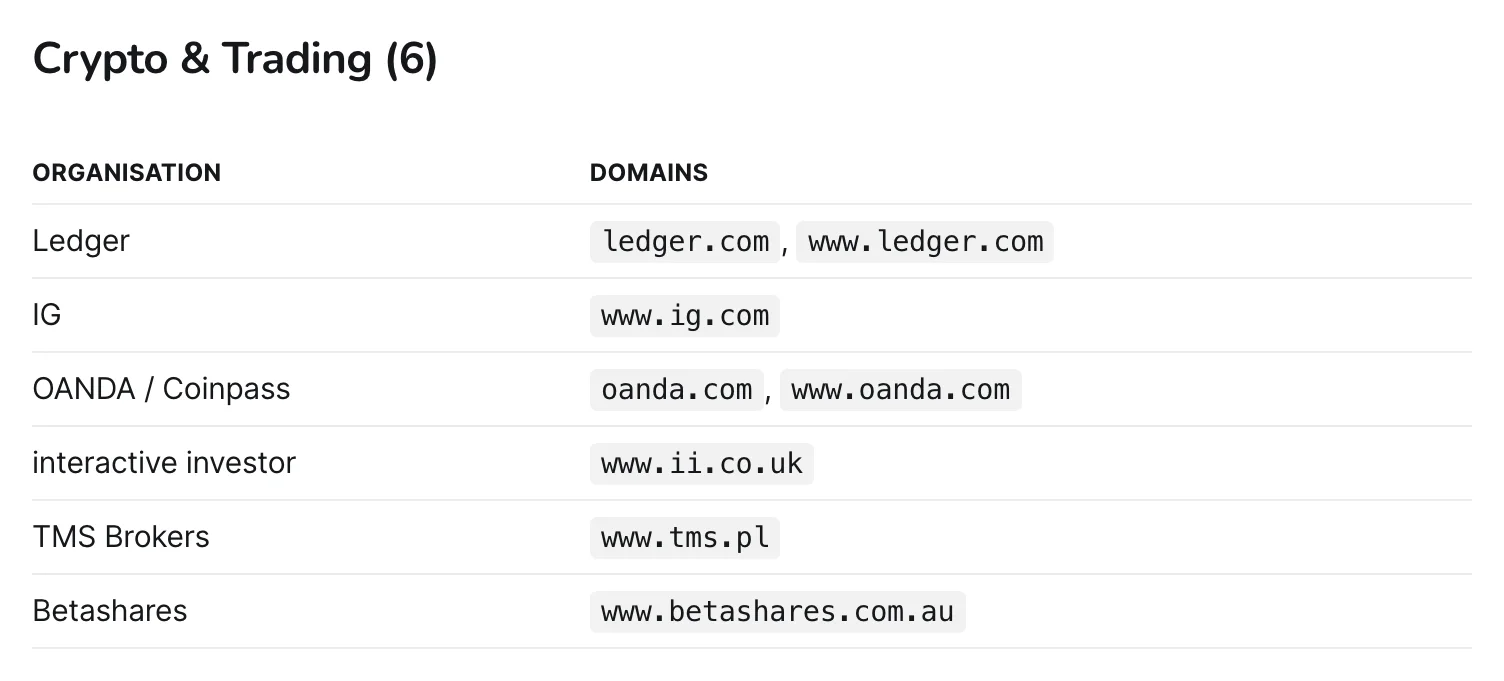
Alex Jovanovic: “Ledger sells a device for people who do not trust the computer in front of them. Until 20:41 UTC on 16 November its own website was running a clipper. I could not have written a better advert for the device.”
What we found on 17 November
On the morning of 17 November we opened the home pages of the four gambling brands and of the crypto casinos we review in a desktop Chrome browser. We recorded every request to an Optimizely domain. Betsson and tombola still load an Optimizely snippet. We downloaded both files and searched them for the attacker’s domains and file names from the published reports. Neither file contains them. PokerStars and Betfred made no request to Optimizely.
Ten crypto casinos from our reviews made no request to Optimizely.
| Site | Optimizely on 17 November |
|---|---|
| Betsson | Loads a snippet. None of the attack’s markers found in it. |
| tombola | Loads a snippet. None of the attack’s markers found in it. |
| PokerStars, Betfred | No request to Optimizely. |
| Duel, Shuffle, Gamdom, Rainbet, BC.Game, Thrill, BetPanda, SpinCrypto, Stake, Housebets | No request to Optimizely. |
How much the attacker made
At 19:25 UTC on 16 November Report URI counted about $7,040 received by the attacker’s wallets: about $5,380 in Bitcoin, $762 in Litecoin, $719 on TRON, $100 in Ether and $82 in USDT on BNB Smart Chain. Its update of 17 November gives slightly higher figures, about $7,150 by our sum.
Alex Thorn, head of firmwide research at Galaxy, traced the same wallets and came to a smaller number. By his count victims sent about $2,300 ($2,266 at 15:00 UTC prices) in 19 payments between 09:57 and 19:57 UTC. Thirteen were under $100. The largest was 15 LTC, about $673. He believes most of the Bitcoin was the attacker’s own money: one exchange withdrawal at 13:18 UTC paid the clipper’s Bitcoin address 0.0761 BTC in three outputs.
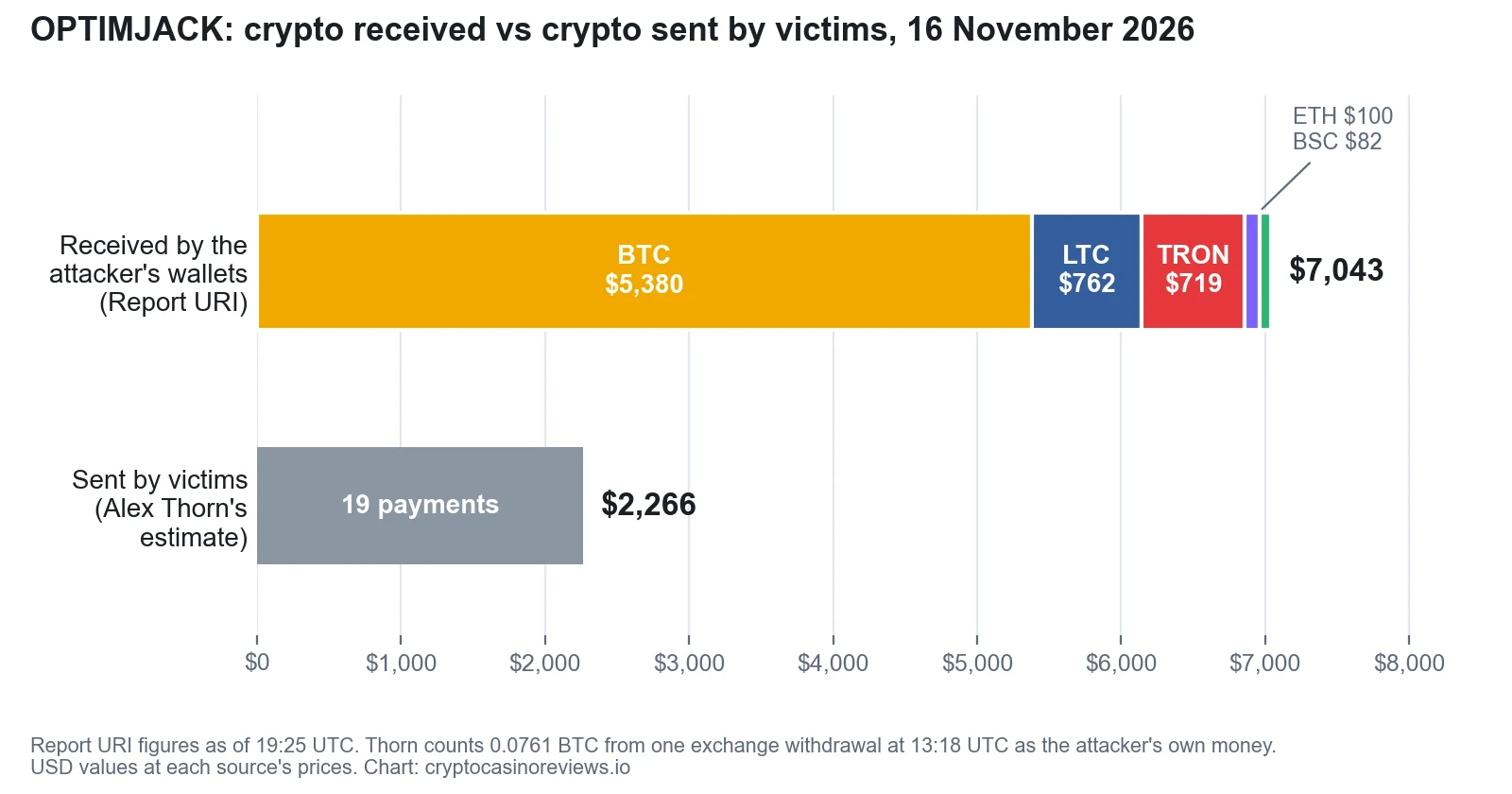
We traced the Bitcoin payments ourselves. The clipper’s Bitcoin address received 0.08528782 BTC in five payments. The 13:18 transaction is one exchange batch with a single input, and its three outputs to the clipper add up to 0.07607213 BTC. Without it, four payments totalling 0.00921569 BTC are left. Both figures match Thorn’s to the satoshi. Who owned the money behind that exchange withdrawal is Thorn’s conclusion.
Thorn wrote that as of 02:20 UTC on 17 November nothing had left the Bitcoin address. At 05:39:48 UTC one transaction moved all of it, 0.08528782 BTC, to a single new address for a fee of 4,320 satoshis. Report URI’s update logs the same move and two more that morning: the Litecoin at 04:11 UTC and 116 USDT on TRON at 04:13 UTC.
Alex Jovanovic: “Someone found a way to put code on Zoom, the BBC and HSBC at the same time, and the crypto side made a few thousand dollars, much of it his own money going round in a circle. If Thorn is right, 19 people lost about $2,300 between them. That is real money for them. As a business plan, it is very poor.”
The attacker’s TRON wallet before the attack
The part of this story that reached casino players came from one post in Thorn’s thread. He writes that the attacker’s TRON wallet was funded on 18 March 2026 by a withdrawal from Gamdom and paid 1,743.60 USDT to a Shuffle deposit address the same day.
We traced the wallet’s USDT transfers. On 18 March the wallet sent five USDT transfers to one address: 243, 250, 250, 500 and 500.597829 USDT, 1,743.597829 USDT in total. The amount and the date match Thorn’s post. The USDT itself had arrived in four payments from three other addresses between 14 and 17 March, and the four add up to the same amount to the sixth decimal place. The only payment in on 18 March was about 67 TRX, the coin that pays network fees on TRON. Thorn’s “funded March 18” can only refer to that payment.
None of these addresses carries a public Gamdom or Shuffle label, so the casino names come from Thorn’s analysis. The address that took 116 USDT on 17 November also received 500 USDT from the wallet on 24 March and 2,000 USDT on 3 November. Report URI says it is the attacker’s cash-out address from earlier operations. It is a different address from the one paid on 18 March.
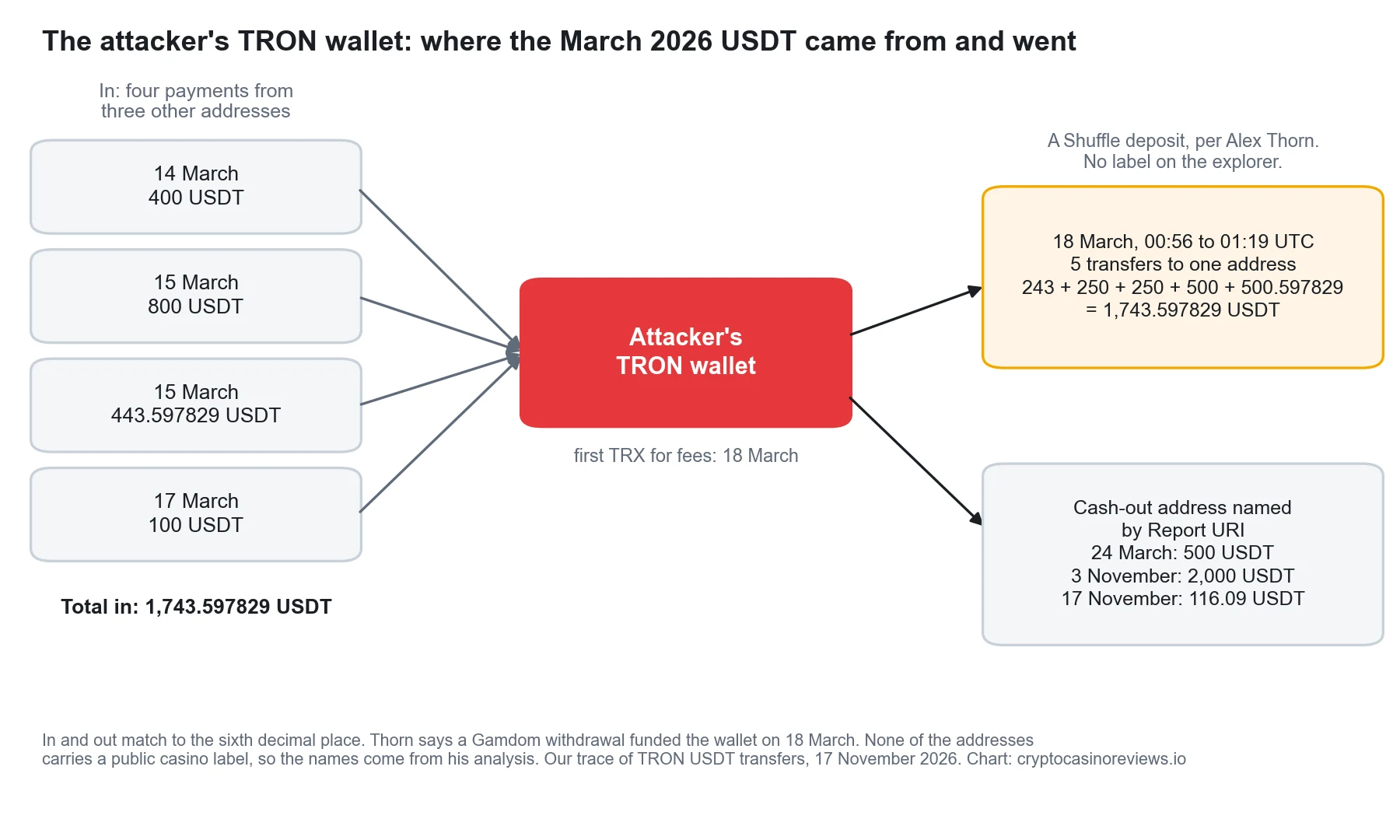
Even if the labels are right, the trail shows a customer using two casinos eight months before the attack. Neither site was on the infected list, and neither loaded Optimizely when we checked. By 13:00 UTC on 17 November neither Gamdom nor Shuffle had commented on Thorn’s post on X.
Alex Jovanovic: “If Thorn’s labels are right, one TRON wallet served for casino play in March, for cash-outs in March and November, and for this attack. The attacker registered fresh domains for the job and kept the old wallet. Thorn calls that sloppy. It also gave researchers a trail back to March.”
That point matters to ordinary players too. Coins that passed through a wallet linked to a theft can get a deposit or withdrawal held at a casino that screens wallets. Our guide to held withdrawals and source of funds explains how that screening works and what to send if it happens to you.
Why site security did not stop it
A Content Security Policy (CSP) tells the browser which domains a page may load code from and send data to. Report URI checked 256 hosts of the affected organisations. 68 had no CSP. At 50 the policy let the payload run and send data out. At 17 it stopped the data theft, but the address swapping still worked. Only 24, or 15%, blocked the payload.
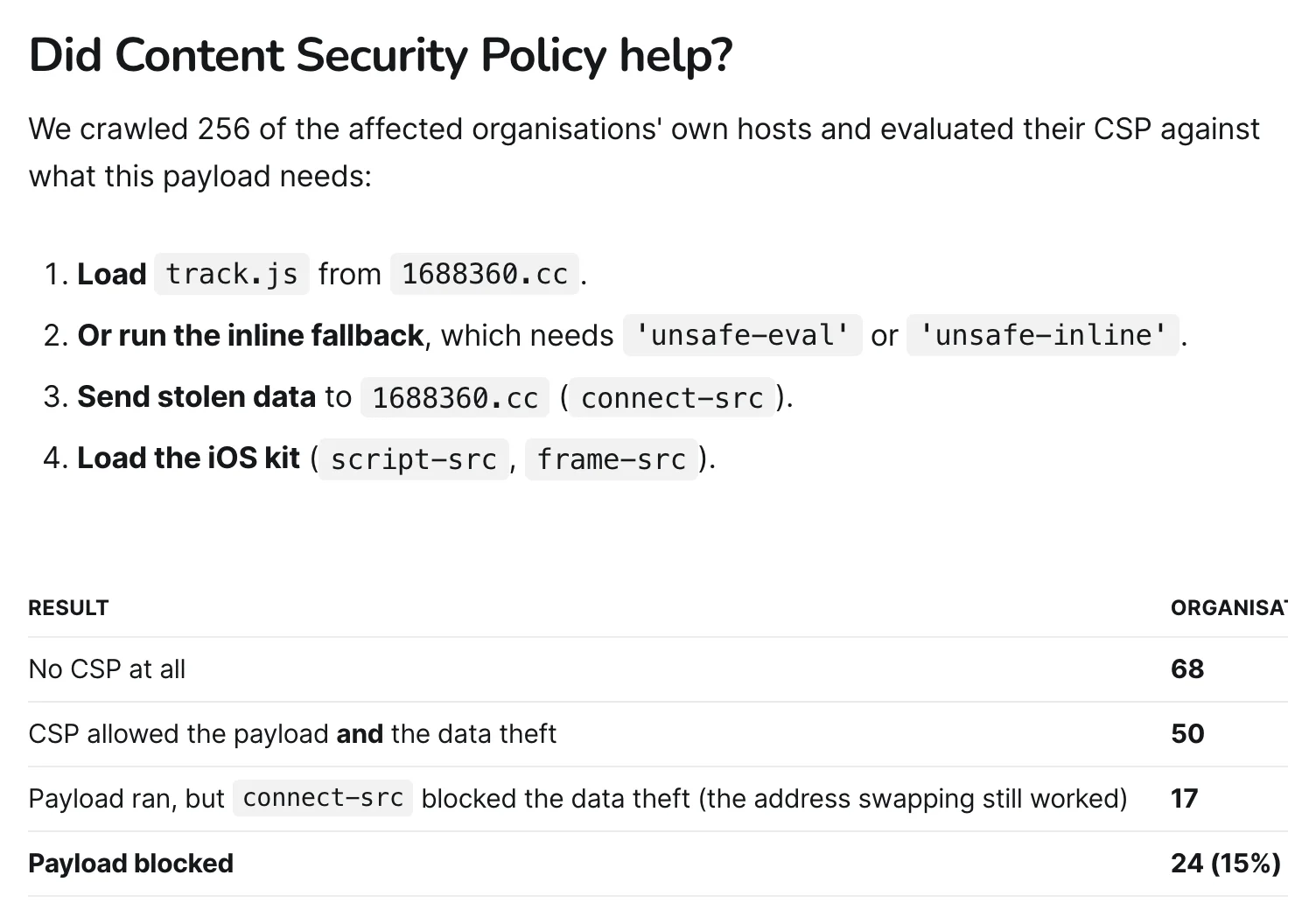
The attacker shipped a backup for sites with a strict policy: a copy of the code inside the snippet, run through eval. Report URI notes that Optimizely’s documentation recommends allowing 'unsafe-eval', which lets that copy run. At HSBC the policy blocked the attacker’s file, and then the copy ran through eval.
Alex Jovanovic: “HSBC’s security policy did its job and blocked the bad file. The copy inside the snippet then ran anyway, because the vendor’s setup guide asks for the exception it needed. For a player the lesson is simple: a big brand on the address bar does not tell you what code runs on the page.”
Checks before your next casino deposit or withdrawal
The attack is over. It showed that a trusted website can carry a clipper. These habits cost a minute and protect every transfer:
- Check the address on the screen that signs. After pasting, compare the address on your wallet’s confirmation screen, or on your hardware wallet, with the one on the casino cashier. Check the first six characters, the last six and a few in the middle. A checksum does not help here, because the fake address is valid.
- Copy with other tabs closed. Report URI’s warning covers addresses copied anywhere while an infected tab is open. Close the rest of the browser before you copy a deposit or withdrawal address.
- Send a small test first to any new deposit address, and wait until the casino credits it.
- Save checked addresses. Use the address book or withdrawal whitelist in your exchange and wallet, so you do not paste an address each time.
- Update iOS to 18.7.3 or 26.3 or later, as Report URI advises.
- Review 16 November. If you sent crypto that day, check that each payment reached the address you meant. If you paid by card on a site from the list, watch your statement. If you were logged in to one of those sites, log out and back in to end old sessions.
Crypto payments cannot be reversed, so a swapped address usually means the money is gone. If it happens to you, report it to the casino and to the police anyway, and keep the transaction ID. For a wider view of how casino money gets stuck after a hack, see our report on the $6.3 billion Binance hack. Our review method explains how we rate the casinos in the table above.
Alex Jovanovic: “On 16 November your clipboard could have been edited by a script loaded on the BBC. The only screen worth trusting is the one on the device that signs the payment. Check it every time, especially when the cashier says Deposit.”
FAQ
What is OPTIMJACK?
OPTIMJACK is the name researchers gave the attack of 16 November 2026 on Optimizely Web Experimentation. An attacker added malicious JavaScript to customer projects, and Optimizely’s CDN served it to visitors of 178 organisations. The code swapped crypto addresses, skimmed card details, stole cookies and screenshots, and pushed iPhone exploit kits.
Were crypto casinos infected?
No crypto casino appears on Report URI’s list of 178 infected organisations. The gambling brands on it are Betsson, PokerStars, tombola and Betfred. On 17 November none of the ten crypto casinos we checked, including Stake, Gamdom and Shuffle, loaded Optimizely on its home page.
How much crypto was stolen?
Report URI counted about $7,040 received by the attacker’s wallets on 16 November, and slightly more in its update of 17 November. Galaxy Research’s Alex Thorn estimates that victims sent about $2,300 in 19 payments and that most of the Bitcoin was the attacker’s own money. On 17 November the attacker moved the Bitcoin, Litecoin and remaining USDT out of the wallets.
Is it safe to use these websites now?
Report URI saw every infected Optimizely file cleaned by 23:11 UTC on 16 November and says they have stayed clean. The attacker’s main server domain was suspended at 00:37 UTC on 17 November. Optimizely says it fixed the vulnerability. Its status page still showed the incident as Monitoring on 17 November.
What did the attacker’s TRON wallet do before the attack?
On 18 March 2026 it sent 1,743.60 USDT in five transfers to one address. That USDT had arrived between 14 and 17 March. Alex Thorn of Galaxy Research says the wallet was funded by a Gamdom withdrawal and paid a Shuffle deposit. The addresses carry no public casino labels, so the names come from his analysis. Neither casino is on the infected list, neither loaded Optimizely when we checked, and by 13:00 UTC on 17 November neither had commented on Thorn’s post on X.
Is my iPhone affected?
Report URI says the code sent exploit kits to iPhones and iPads on iOS 13 to 18 and only recorded details from iOS 26. It advises updating to iOS 18.7.3 or 26.3 or later. Report URI says it has no way to see how many devices were infected.
Gambling is for adults only and can become addictive. Play only with money you can afford to lose, and read our responsible gambling guide if it stops being fun.

Written by
Alex writes the house files on Crypto Casino Reviews. He plays the desks he scores and checks the offer, the cashier, and the licence before the long read.
Reader desk
Comments
Played at this casino, spotted a mistake or have a question? Write it here. Alex reads every comment before it goes live.